Bowman's Pro Turf, LLC.
Servicing the Wabash Valley since 1987
DIY Lawn Care Tips
You might have considered doing lawn treatments on your own. After all, how hard can it be, right? Before you get started, you need to first consider a few things. Here are our tips for you to be successful for your own DIY lawn care.
Timing of Applications
One of the biggest mistakes that anyone can make when planning a lawn treatment schedule is not understanding proper application timing. This is an easy mistake to make if just going off of what the big box stores sell through their standard packages. Some stores offer a 4 step program while others market a season control package.
Crabgrass pre-emergent needs to be applied before the seed can germinate. For the Wabash Valley that is typically around April 15th. The closer to this date the better control you will see. Post-emergence herbicide applications should only be applied when soil temperatures reach the stated level on the product label.
Some granular fertilizer products have herbicides included. Be sure to read and follow all instructions as some of these products require to be watered in to activate the ingredients for best control.
Mowing Practices
Some of the simplest things that a homeowner can and should do is to have proper mowing habits. These mowing guidelines are directly from Purdue Universtiy Turf Science Department and should be strictly followed.
- Mow the lawn now shorter than 3.5 inches.
- Mow in different directions every week.
- Cut no more than 1/3rd of the grass blade off at a time.
- Avoid mowing during the hottest part of the day.
- Only mow if the lawn truly needs it.
- Do not bag clippings from mowing.
Selecting Products
Looking at the lawn care aisle can be very confusing. So many different products with active ingredients that have every letter of the alphabet. What does all of this mean? Different active ingredients will target specific weeds. If you apply a product that contains 2-4D in hopes that it will kill crabgrass, you will be wasting your time and money. Be sure you properly identify the target plant and select a product that is labeled to kill that plant. All the information that you need to know about each product is listed in detail on the label. It is very easy to apply the wrong product and end up doing more harm than good.
Understanding Nature
When doing lawn care, you have to remember that you are trying to change what nature has been designed to do for years. Weeds will germinate over the course of months so do not be surprised if you make an application and a few weeks later more of the same weeds begin to appear. Rain, lack of rain, heat and cold all are out of our control. Some products can only be applied if they are watered in while others require the lawn to stay dry. It is also important to check temperature restrictions on products because applying them outside of what the label states is not only dangerous but against the law.
Fertilizer Selection and Application
When selecting what kind of fertilizer you want to apply to your lawn you first need to understand what is in the bag. Every bag of fertilizer has a guaranteed analysis of 3 numbers in a 0-0-0 format. The first number is the percent of Nitrogen, the second number is the percent of Phosphorous, and the final number is the percent of Potassium. Each nutrient has different qualities that prove the turf with different benefits. We suggest following the guide published by Purdue University to determine what fertilizer you should apply.
After you select the fertilizer you want to use, you need to determine how much you need to buy. Most bags of fertilizer purchased from a major store will state how many pounds per thousand square feet should be applied. To determine how much fertilizer you will need to buy, you need to know how many actual square feet of turf you have. Once you determine that, you can almost begin your fertilizer application.
There are several pieces of equipment that can be used to apply fertilizer. Be sure that whatever equipment you use is properly calibrated and you fully understand how the equipment works. A hand spreader, broadcast spreader, or drop spreader can be used to apply products but are each unique and present different challenges when making applications.
Making the Application
Now that you understand proper mowing techniques, you have purchased the equipment you are most comfortable using, you have measured your lawn, you have all the right products, it is time to make your application. We recommend checking out the homeowner section of Purdue University Turf website for very detailed and specific instructions on how to best make your first application.
After you complete your application it is always a good practice to record time, date, products applied, and how much product was actually used. These records can come in hand should you see issues later on before your next application.
Final Thoughts
Doing a proper lawn care application to your lawn requires more than just any bag of 10-10-10 fertilizer and bottle of 2-4D. A real understanding and knowledge of plant biology is crucial to making successful applications to your lawn. This knowledge and understanding should come from accredited institutions with scientific research backing up everything and not just “some neighbor down the street.” When it comes to actually making an application of products to your lawn, be sure that everything is calibrated correctly and all pieces of equipment are in working order. The slightest miscalculation can result in disaster!
If you ever have any questions, we always recommend contacting a licensed professional. Purdue University is one great resource that anyone can access. They have very informative and easy to understand publications for homeowners regarding this and other topics relating to lawn care and maintenance.
Summer Lawn Recommendations
The months of June through August always seem to bring some challenging conditions for the lawn care industry. Most of these conditions will present issues that are out of our control. If we maintain proper lawn care practices, we can help our lawns overcome and combat this environmental stress and make it through the summer as healthy as before.
Heat Stress
As the temperatures rise, you will see your lawn and landscape begin to cope with this added stress. Most of the lawns in the Wabash Valley are made of cool season grasses. These grasses grow best when temperatures are between 72 and 84 degrees. As the temperatures rise, cool season grasses will slow down in growth or even go dormant. This is one way that nature protects itself against the environment.
Be cautious when mowing your lawn during high heat times. Sometimes, you can damage your lawn and cause striping from the weight of the lawn mower tire tracks if mowed during the hottest part of the day. If this happens, your lawn is under a lot of stress and you should consider irrigation to help the turf recover.
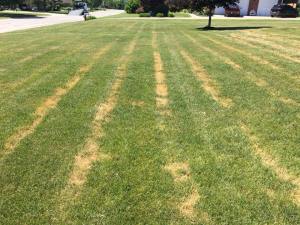
Heat stress damage from improper mowing.
Drought Stress
Along with heat stress, we often see lawns go dormant due to lack of water. The turf will display the same signs as in heat stress. Slowed growth and brown foliage are common signs of early drought stress. Areas of your lawn may display this stress more pronounced if there is something under the surface of the soil such as a septic system. Below, you can see an example of how a septic system shows up during times of dry weather.
Turf that is experiencing this kind of stress will recover as proper irrigation is resumed.

Drought stress.
Irrigation Recommendations
Lawns need about 1.5 inches of water each week to maintain health. As water become scarce, your lawn will begin to go into drought stress. If you have an irrigation system installed in your lawn, make sure you set the system to run in the early morning, between 5 AM and 7 AM. Your lawn needs a lot of water so it is best to water infrequently for long periods of time. Every other day for 30-45 minutes will give your lawn a healthy deep root watering. When water is only applied for a short amount of time, it is not encouraging the roots to reach deeper. Poor watering can produce shallow roots and in the long term will greatly impact your turf health.
If you water your lawn at night, you are encouraging turf diseases to set in. As the summer months drag on, we will see high humidity. Night time humidity and improper lawn irrigation is a breeding ground for diseases.
Mowing Recommendations
Since turf is made up mostly of water, during these times of high heat and little rain, proper mowing practices are key in ensuring your lawn makes it through the summer. While it may be tempting to mow by your regular schedule from the spring, your lawn may not really need it. Mowing just to mow is never a good habit. When you mow, make sure that you mow no more than 1/3 of the leaf blade at a time. Never mow your lawn below 3 inches in height, especially in these hot conditions.
Mow in different directions every time to ensure that you are not causing more unneeded stressed on the lawn.
If you hire a mowing service, make sure they are following these rules. Beware of some bad business practices. It has been reported that mowing crews will begin to lower the mowing height on their machines when lawns slow down in growth. Do not let a mowing crew on your lawn if the lawn really does not need it.
Seeding Preperations
Over the next few months, we will begin our seeding preparations for the fall. While it may be tempting to throw seed out now, the best time to seed is between August and September. As we get closer to that time, you may begin to consider seeding your lawn. If you decided to seed in the fall, make sure you are prepared with the proper watering expectations. Seed will only germinate if it is watered correctly.
Weed Control and Fertilization
If you are doing your own lawn treatments, be very careful to follow all label instructions of any products that you apply. Many herbicides and fertilizers have temperature restrictions and water requirements. Fertilizers applied improperly during times of severe heat and drought stress may damage the lawn.
The products that we use are manufactured differently than what you can purchase at your local lawn and garden center. Our products have protective coatings that allow for nutrients to be released as soil conditions allow. The slow release component to our products is a huge benefit during the summer months as it allows your turf to take up the nutrients as it needs. Most consumer fertilizers do not have this technology and in the end can hurt your turf.
What have we seen so far this year?
Our season begins in late February and we have been through just about every season of weather so far this year. The spring began colder than usual mixed with consistent rain. This cold weather delayed the weed germination of many common spring time weeds. As soon as the cold left, May was then the hottest May on record. We also experienced a long period of little rain. These conditions started to put lawns into early stages of heat and drought stress. Some turf diseases began to appear in Mid-May as high evening humidity persisted.
As conditions change, so will your lawn. Know that these conditions are usually temporary and with proper cultural practices, your lawn will bounce right back. Many of the issues caused by heat and drought stress will be unnoticed as the weather conditions become more favorable to the turf.
Safety
For your peace of mind, here are some important safety guidelines to consider with your Early Spring Lawn Application:
- Please remove the yellow lawn posting 24 hours after the application.
- If a liquid herbicide was applied, please stay off the lawn until the product is dry.
- All of our products are approved and regulated by the EPA and Office of the Indiana State Chemist. We follow all guidelines listed on the label of the products as it is the law. Proper personal protections such as long sleeve shirts, long pants, gloves, and safety glasses must be worn when making an application. If you ever see any technician from any company making an application without any of these pieces of safety equipment, they are breaking the law!
If you ever have any questions about your lawn applications, please call us at our office! Full service customers have free service calls for between treatment spot treatments.
Fall Lawn Care Must-Do’s!
As the growing season is coming to a close, it is very important to maintain healthy lawn care practices to prepare your lawn for the best winter possible. Lawns are living organisms and as the coming months bring changes in weather, we need to understand how to best prepare the turf as it enters dormancy for the next few months. By following our proven steps, we guarantee that your lawn will not only be on track for a successful winter, but also enter next spring on the right foot.
Balanced Fertilizer
Throughout the growing season, we stress the importance of a balanced fertilizer program. As the seasons change, the needs of the plant also change. In the spring, the turf uses nutrients in fertilizer to produce energy to form seed heads. Appropriate nutrition in the summer months allows for cool seasons grasses to better fight off diseases or fungus.
In the fall, plants begin to focus their energy on nutrient storage in the root system. A late fall fertilizer should focus on strong and healthy root development. Skipping a fall fertilizer application can deny the turf with the nutrients it will need to have a successful dormancy. Often times, the effects of skipping a fall fertilizer application are not noticed until the spring.
Weed Control
Many of the weeds that are present in Central Indiana lawns in late fall are also present in the early spring. Fall weed control applications are very important as they kills weeds that can linger all winter and begin growing in early spring. When we see those weeds growing in February and March, we are unable to safely apply a herbicide that can effectively kill those weeds.
Mild are and ground temperatures in the fall provide for a great opportunity for a final weed control clean up for the year. Applying the proper herbicide with the correct formulation will provide for a much cleaner lawn now and in the spring.
One indicator for quality control we always look for in lawns in the early spring what weeds are present. Many of the dandelions and clover should be killed with properly applied fall applications. Because of the timing of these applications, we find that lawns treated properly in the fall will be cleaner in the spring.
Mowing Height
Maintaining a mowing height of at least 3.5 inches for cool seasons grasses applies for year round lawn maintenance. In preparing a lawn for the winter months, root zone development is crucial in turf grass. Mowing at a proper height of 3.5 inches ensures that the root zone is not damaged by bad mowing practices.
Some say to mow shorter and shorter the closer we get to winter to prevent diseases such as snow mold. The reality of this disease damaging a lawn in Central Indiana is highly unlikely. Snow mold on properly mowed turf typically will not even show signs of symptoms until after 40 days of snow cover. For the Wabash Valley, it is very hard to find records of the last time we had 40 days of snow covering the ground. Even if all of the conditions are present in your lawn, a taller turf will show fewer symptoms and be more able to come out of the disease as weather changes.
Leaf Removal
As the growing slows in your lawn, you will still want to consider leaving the mowing height at 3.5 inches and mow over all of the leaves as trees begin to drop. By mulching and mowing over the leaves, you are providing added nutrients and microbial back into the soil to feed the microorganisms that help to keep your lawn healthy. Mulching often takes less time and is more environmentally friendly than raking or burning.
If you live in a city where they will collect the leaves to compost, you may choose participate in that program as well. Keep in mind that if you pile the leaves in the tree row, it can damage the existing turf and by the time the leaves are removed, it will be too late to plant new grass seed for that year.
Lawn Mower Maintenence
As the season ends, be sure to spend some time providing maintenance to your lawn mower. Refer to your specific lawn mower owners manual for instructions on changing oil, air filters, spark plugs, or other parts that break down over time. We always recommend checking the mowing blades several times throughout the season. Replace dull, bent, or chipped lawn mower blades and ensure all belts are free from any excessive wear. A properly stored lawn mower in the fall will make for a much easier start in the spring.
By following these steps, we can ensure that your lawn will be prepared for the winter months and enter next spring healthy and ready to grow! If you have any questions about lawn care or our program, please feel free to let know. You can always reach us through our website, Facebook, or Email.
 Bowman's Pro Turf, LLC.