Bowman's Pro Turf, LLC.
Servicing the Wabash Valley since 1987
Should I seed in the Spring?

As winter begins to thaw in the Wabash Valley, many people are beginning focus on their lawn to begin planning the upcoming growing season. While we use the spring to plan our gardens and plant flowers, we need to be aware and remember that spring is not the best time to plant grass seed.
While the best time to seed a lawn in Indiana is between August and September, we do have a few exceptions to this rule. That does not mean that a spring seeding is foolproof and does not require some patience. A spring seeding may be necessary on a lawn or area that is completely bare of any desirable turfgrass. This could be from winter damage, a new construction project, or a change in landscape layout. Waiting until August may not be ideal so if you have to seed in the spring here are some key things to remember.
Weed Control
When you plant any grass seed, you must be aware that you will face serious limitations on what kind of weed control can be applied and when. For a spring seeding, be sure to avoid any kind of crabgrass preemergent to the areas you wish to grow new grass seed. The crabgrass preemergent can hinder the root development of new seedlings and prevent proper germination and growth. It is also typically recommended, as per the herbicide label, to not apply any post emergent herbicide until you have mowed the newly established grass at least 4 times.
Water
Anything you plant will need water. If you decide to do a spring seeding while the ground is still frozen, the moisture in the soil may be enough to get things moving but you still need to consider that you may have to provide additional water to sustain the plant life. Seed requires soil temperature to be in the mid 50’s before it will begin to think about germination so you may be looking at early April before you see new grass growth. Begin watering as temperatures allow.
Heat/Drought Stress
Since the new grass will be young and tender going into Summer, make sure you keep up on irrigation and a nutrition plan. The new grass will have to be monitored as it will not have developed a full and strong root system before the heat and drought stress of June and July move in. Plan to continue to apply water several times a week to these seeded areas to ensure you do not have too much die off from these stressors. Usually by this time you can begin to apply herbicide. Be cautious when applying herbicide to new grass that is under drought stress as it can harm and stunt its development.
Reseed in August/September
No matter how successful you think your spring seeding turns out, consider a proper overseeding in August/September. This will ensure the area continues to fill in and you can achieve even better results.
Anything you do in a lawn or landscape is a process and does take time. Growing a thick and healthy lawn sometimes requires more patience than products as we sometimes have to sit back and wait for things to happen on their own in nature. A plant can only take up nutrients so fast and water provided through rain may not be enough to sustain a turf.
As long as you keep in mind the above points, you may be able to complete a successful spring seeding.
Crabgrass Control Basic Facts

Why is crabgrass preemergent timing so important?
Every year we receive phone calls late into spring of hopeful homeowners asking if there is still time to apply the crabgrass preemergent. Sometimes, we are well past the appropriate timeframe with to successfully apply a preemergent.
While we do change our products to meet the growing conditions, sometimes it is just too late. Below are some basic facts about crabgrass preemergent applications.
Timing
For most successful lawn care companies, we usually begin our first application well before when you will be thinking about mowing your lawn. While the turf may be slowly coming out of dormancy in the early part of March, we are already well into applying a heavy rate of crabgrass preemergent to our lawns. Timing is crucial to the success of your preemergent application but there are also some other factors that can play into the long term success of a treatment.
There are several kinds of products on the market and most of the time, professionals choose a low nitrogen product that is 100% slow release. This allows us to make a very high rate application of crabgrass preemergent while not loading the lawn down with nitrogen. The slow release component ensures that the nutrients that we apply will be available over 6-8 weeks as the lawn moves out of dormancy.
When applied properly, a high quality crabgrass preemergent can last in the soil for 180 days. For those keeping score at home, If we apply the first application on February 26th, that means the active ingredient should still be present in the soil into August. Throughout the early months of the application season, we are closely watching the average soil temperature to a depth of 2 inches. Once soil temperatures near 55 degrees, we make a change in active ingredient selection to target crabgrass as a preemergent but also with a little post emergent activity to catch any very small crabgrass plants that might be growing.
How does it work?
Not all crabgrass preemergent is the same so before we make a selection of products, we need to understand the chemistry of what we choose. For our company we select a product and apply it at the highest rate allowed to maximum coverage and efficiency. This preemergent is adhered to a fertilizer prill. Once the application has been applied, moisture from the soil and eventual rainfall help to work the active ingredient down into the soil to create a chemical barrier. As crabgrass seeds in soil have an opportunity to germinate, the chemical barrier prevents root development and stops germination.
Different things can affect the success of a crabgrass preemergent application. The most common area we see crabgrass breakthrough is along edges and high traffic areas. Heat from sidewalks, roads, and buildings can degrade the chemical barrier but also if these areas are trimmed using a string trimmer, the chemical barrier will be broken and allow for crabgrass to breakthrough.
Thin areas and parts of the lawn that are bare also tend to have crabgrass breakthrough. These areas provide less competition for weeds and are more susceptible to chemical breakdown.
How to get the most out of a preemergent.
One of the simplest things to do for your lawn is ensure you are mowing at no shorter than 3.5 inches. Tall turf gives your lawn a healthy root structure and an overall healthier plant. Taller turf also helps to shade the soil which in turn protects the chemical barrier from heat degradation. If you think about it, when have you been walking through the woods and seen a healthy crop of crabgrass? Crabgrass hates shade and tall turf provides enough shade to help prevent crabgrass with a good preemergent.
Reseed in the late summer to fill in the lawn a grass seed blend that is strong for your area, soil conditions, and area use. Take into account if it is a shady or sunny area when making your seed selection as well. Not all turf grass seed blends are equal but that will be discussed in a different post.
Should You Seed In The Spring?
A few weeks ago a customer asked us to complete a seeding and aeration this coming spring, if we felt it would be beneficial.
Unfortunately, there is no appropriate time in the spring for a seeding and aeration. Spring seeding is not recommended for the following reasons.
1) A spring seeding would prevent any use of chemical applications for about 3 months. This means no crabgrass preemergent or post emergent herbicide can be applied.
2) Seed that is planted in the spring has about a 50% chance of germinating and surviving. Spring is a very difficult time for grass to grow and become established as spring diseases are rampant in lawns. While most diseases present in lawns are not fatal to mature turf, to new seedlings, it is almost always fatal.
3) Any grass that does germinate and grow will need to be watered continually to ensure survival. The young root system and crown of the plant is extremely tender and once we reach consistent temps over 80 degrees, turf slows down on growing. New grass does not have a well enough established crown and roots to survive the heat and drought stress we always have during the summer.
4) Aeration in the spring does more damage than good. Aeration works to provide the benefit of loosening the soil, however, the spring usually has saturated ground. An aeration in the spring can cause a muddy mess and create other issues. Additionally, turf does not respond well to a spring aeration due to the biology of the growth cycle. In the spring, turf is focused on shoot growth. When we aerate, it damages and cuts the roots. When we do this in the spring, the roots get cut and the plant is not going to repair them causing additional damage.
Most of the time, a spring seeding is unsuccessful and the lawn will have to be reseeded in late summer/early fall.
The following link is to a publication from Purdue University regarding seeding.

If you were going to consider spring seeding, it would be done by simply broadcasting the seed over the lawn in late winter. The continued freezing and thawing of the soil works the seed to the soil. If that is done, no weed control could be applied for several weeks and no typical crabgrass preemergent can be applied. There are some exceptions to the rule with special order products but in those cases, it sometimes can be cost prohibitive.
New Grub Preventative Plus

Over the last 5 years, the Wabash Valley and Midwest have seen an increase in turf destroying insects. While we have focused primarily on white grub control, it is now time to add to our list of threats to our lawns and landscapes. When thinking of a grub preventative program, it is now more important than ever to be sure your insecticide includes control for more than just grubs.
In 2024 we made a drastic change in the insecticide that we used on turf for our grub preventative program. While the chemistry for imidacloprid (Merit) has its place in the lawn care industry, it was time to make a change. For many years, Merit was a great product to use for a grub preventative program, however, with the increase in other turf destroying insects, a change was needed in our program to ensure we provided the right protection for lawns. Merit works well against grubs but does not work against caterpillars. We needed to switch to a product that provided control for a wider range of insects. We also found that Merit has a small window of application and only provided preventative control with no curative control if an early emergence of grubs appeared. This limited our ability to keep up with the ever changing environment we have seen over the last 5 years.
Moving forward, our grub preventative program will now control more than just white grubs. The product we are using will not only control white grubs but also armyworms, annual bluegrass weevil, billbugs, European crane fly, spittlebugs, cutworms, sod webworms, and provide suppression for chinch bugs. This product can be applied from early spring to as late as September for both a preventative and curative solution to turf destroying insects.
Below are just a few local examples of some of the insects that we will now have great control over with our improved Grub Preventative Plus. We are calling it Grub Plus because of the added benefit of controlling more than just white grubs. All customers who already have our grub preventative treatment scheduled will receive these great control benefits for their property. If you are interested in adding this highly effective treatment to your program, please reach out and we can get it scheduled.
Armyworms
In 2021, we saw our first glimpse of what was to come when armyworms invaded the Wabash Valley. These pests were brought to us through the winds of tropical storms and settled on our lawns, destroying them overnight. Since 2021, armyworms have been found in Indiana. Damage will likely continue as these pests travel up through tropical storms and land in the Wabash Valley.


Billbugs
The most common lawn destroying pest in Indiana is the bluegrass billbug. While bluegrass is in the name, it does not discriminate against cool season grass types and has even been known to attack warm season grasses. In 2024, we sent several samples to the Purdue Plant and Pest Diagnostic Laboratory and almost all of them came back with billbug damage. Billbug damage is the most commonly diagnosed insect-related turfgrass issues in North America. Damage begins at the crown and root of the plant and progresses from the feeding of the insect.


White Grubs
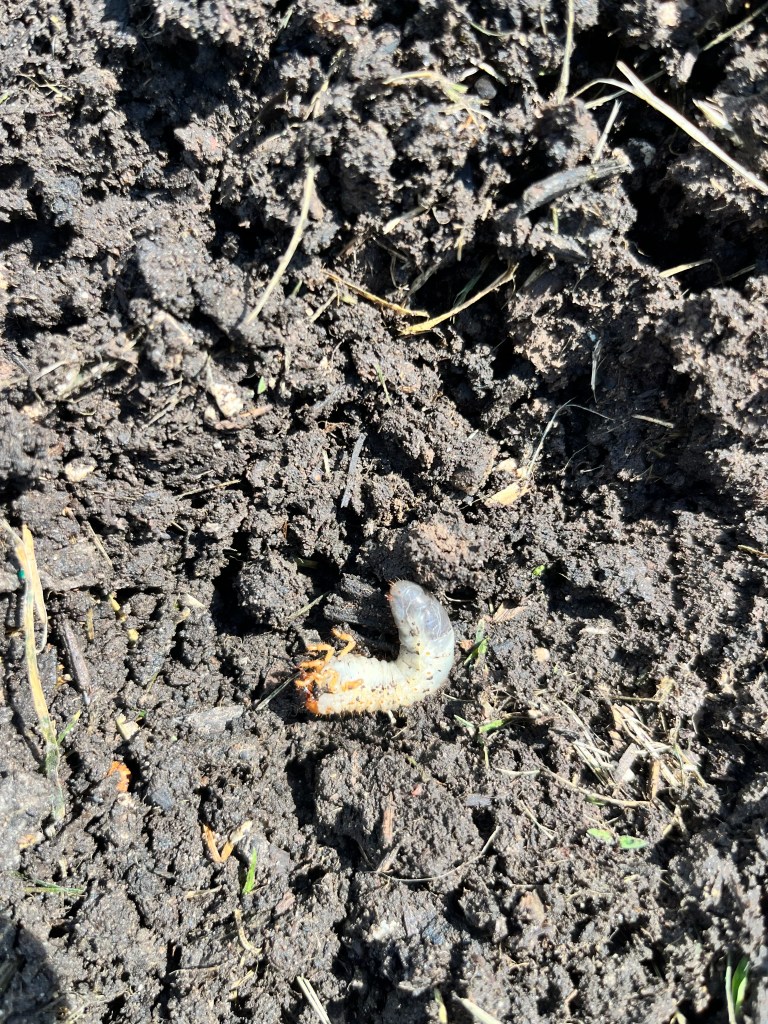
White grubs are probably the most commonly thought of turf destroying insect among homeowners. While there are several kinds of species of grubs: Masked Chafer, Japanese Beetles, European Chafer, Green June Beetle, and Oriental Beetle; the damage and life cycle are all similar. Grub damage can appear as brown spots and slowly spread, similar to billbug damage. To be sure, we use what is called a tug test to see if the turf pulls away from the soil. Damage from white grubs happens both from the grubs feeding on the turf and from animals such as skunks, racoons, and turkeys foraging and feeding on the grubs.

 Bowman's Pro Turf, LLC.